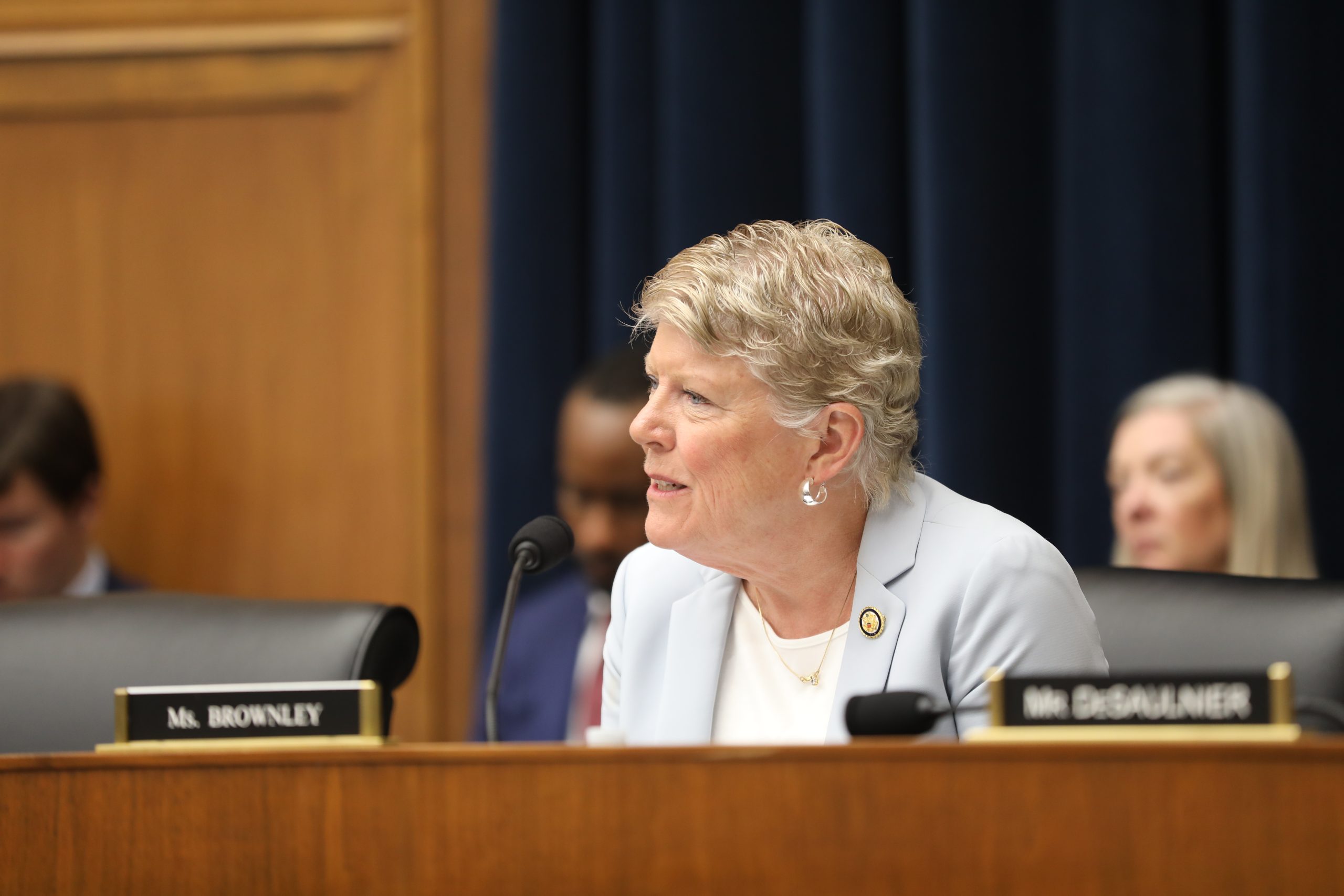
Washington, DC – Today, Congresswoman Julia Brownley (D-Calif.-26), Senator Adam Schiff (D-Calif.), Congressman Salud Carbajal (D-Calif.-24), and members of the California congressional delegation are launching an inquiry into Sable Offshore’s efforts to restart oil drilling off the California coast and are demanding answers on the company’s collaboration with the Trump administration to invoke the Defense Production Act (DPA) in relation to this project.
In a letter to Sable Offshore Corp.’s CEO and Chairman Jim C. Flores, the lawmakers raise concerns about the timeline of Sable’s accrued lawsuits, cease and desist orders, fines, etc. dating back from April 2025 to March 2026. They demand Sable preserve all of their internal communication records between the company and administration officials related to the restart.
“The administration’s reliance on the Defense Production Act (DPA)—no doubt in consultation and coordination with lawyers representing Sable—is a serious misuse of a federal law meant to be involved for national security reasons, not to enrich an industry already making record profits. To help Congress better understand this effort to circumvent California law and coastal protections, we seek detailed information on the company’s role in this decision, and your communications with the Trump administration in relation to Sable Offshore’s SYU project,” the lawmakers wrote.
The lawmakers also point to concerning financial ties between Sable and President Trump, including executives at Sable directly contributing to the president’s campaigns. They emphasize that Sable has closely worked with the Trump administration to restart the oil pipelines that have been dormant for over a decade all in an effort to “benefit industry partners and preferred energy sources” rather than protect our coastlines.
“Californians do not want oil production restarting along their coasts and have voted repeatedly for California laws that block coastal oil production. The environmental impacts, along with the economic fallout from those impacts, are simply too great, especially when there is little to no benefit for California consumers. We urge you to pause and consider the long-term legal and financial ramifications of collaborating with the Trump administration to circumvent California law,” the lawmakers concluded.
In addition to Brownley, Schiff, and Carbajal, the letter was signed by U.S. Senator Alex Padilla (D-Calif.) and U.S. Representatives John Garamendi (D-Calif.-08), Jared Huffman (D-Calif.-02), Mike Levin (D-Calif.-49), Dave Min (D-Calif.-47), Jimmy Panetta (D-Calif.-19), Speaker Emerita Nancy Pelosi (D-Calif.-11), and Mike Thompson (D-Calif.-04).
The full text of the letter can be found here, and below:
Dear Mr. Jim Flores:
We write to express our grave concern over the restart of Sable Offshore Corporation’s (Sable) Santa Ynez Unit (SYU) offshore oil activities near the coast of Santa Barbara, California, and your company’s disregard for California law and the well-being of our constituents. The administration’s reliance on the Defense Production Act (DPA)—no doubt in consultation and coordination with lawyers representing Sable—is a serious misuse of a federal law meant to be invoked for national security reasons, not to enrich an industry already making record profits. To help Congress better understand this effort to circumvent California law and coastal protections, we seek detailed information on the company’s role in this decision, and your communications with the Trump administration in relation to Sable Offshore’s SYU project. We also demand that all relevant documents and records pertaining to the SYU project as described in detail below be preserved.
In February 2024, your family-owned special purpose acquisition company, Flame Acquisition Corp., struck a deal with ExxonMobil to acquire SYU for roughly $700 million, creating the Sable merger. Given the liabilities attached to SYU operations, including ten years of platform and equipment inactivity, challenges with complying with State regulations, and twenty-seven other risk factors identified in Sable’s Securities and Exchange Commission (SEC) 10-K Form, this was a risky purchase.
Since April 2025, Sable has accrued multiple lawsuits, shareholder complaints, notices of violation, cease and desist orders, and fines from California state agencies and nonprofit organizations. Sable has responded by disobeying directives and filing counterclaims for monetary damages. A timeline of state agency and court penalizations are outlined below:
April 2025: The California Coastal Commission (CCC) issued an $18 million fine and cease and desist order against Sable for unpermitted work that harmed habitats and waters on California’s coastline in violation of California’s Coastal Act. At the hearing, CCC staff presented evidence of Sable ignoring state orders; Sable had previously received two cease and desist orders from CCC for violating the Coastal Act and Sable responded by suing the CCC and vowing to continue work in defiance of the order. In October 2025, Sable filed a complaint seeking over $347 million in damages from the CCC, claiming “unlawful delay” of the pipeline restart.3 The CCC won a preliminary injunction against Sable in May 2025.
July 2025: Multiple class action lawsuits were filed by Rosen Law Firm and Schall Law Firm on behalf of purchasers of Sable securities, alleging the company made misleading statements by claiming they had restarted oil production when they had not. Sable is also currently under investigation by the SEC for allegations of advance information being shared selectively among company insiders in October 2025, right before Sable raised $250 million by selling shares of its common stocks to private investors to help keep the company afloat. This same month, a Santa Barbara court placed a separate injunction against Sable preventing the restart of operations unless and until Sable obtains all necessary state approvals.
September 2025: The Santa Barbara County District Attorney John Savrnoch filed 21 criminal charges, including five felony counts, against Sable for unlawful discharge of pollutants into waterways and improper excavation during pipeline repair. The District Attorney alleged that these actions are in violation of the California Fish and Game Code and the Water Code. Sable responded by calling theses criminal charges “inflammatory and extremely misleading” and a “politically motivated attack”.
October 2025: The California Office of the State Fire Marshal determined that Sable had failed to comply with safety standards on its pipeline corrosion repair work and therefore its restart could not proceed. That same month, on behalf of the Central Coast Regional Water Quality Control Board, the California Attorney General, Rob Bonta, filed a lawsuit against Sable asserting three causes of action: 1) Sable repeatedly discharged or threatened to discharge waste to waters of the state without authorization, despite being notified by the Central Coast Water Board that permits were required for the activities; 2) Sable activities resulted in the discharge of sediment and vegetative debris to various bodies of water inland and near the Gaviota Coast, harming water quality and aquatic habitat; and 3) Sable failed to submit information to the board that was required by law. Sable responded by working with the Bureau of Ocean Energy Management to update its federal Development and Production Plan to allow the company to bypass its onshore pipeline and use a floating barge operating in federal waters (an Offshore Storage and Treating Vessel).
March 2026: Department of Energy (DOE) Secretary Chris Wright issued an order claiming that SYU oil production was a national security concern invoking the Defense Production Act (DPA), which unlawfully superseded state laws and restarted SYU oil production. On behalf of the State of California, Attorney General Bonta responded by filing a lawsuit against the Trump administration to halt the use of the DPA Order as a basis for executive overreach. The lawsuit alleges that the DPA Order, which DOE issued at Sable’s request, violates the Administrative Procedure Act and infringes on California’s sovereign power under the Tenth Amendment. The Department of Justice Office of Legal Counsel opinion supporting DOE’s move to invoke the DPA explicitly references a letter from Sable through Holland and Knight to the DOE General Counsel requesting the invocation of the DPA.
The Trump administration has clearly been working hand in glove with Sable to try to force the restart of SYU. For example, the Bureau of Safety and Environmental Enforcement (BSEE) made misleading statements about SYU oil production in July 2025 that paralleled statements made by Sable, the same statements that resulted in securities class action lawsuits by your shareholders. California Congressional Members also requested further information about these statements in a letter to DOI Secretary Doug Burgum and BSEE Deputy Director Kenneth Stevens. To date, we have not received any response. While this fight between California and the Trump administration continues, these actions suggest that the Trump administration is willing to circumvent state laws to benefit industry partners and preferred energy sources, and you appear to be a willing partner in its efforts.
Furthermore, we have concerns regarding financial ties between Sable and President Trump. Executives at Sable have directly contributed to President Trump’s campaigns. You have contributed over $300,000 to Super PACs like Right to Rise USA and Senate Leadership Fund, which made contributions to President Trump’s 2016 and 2024 campaigns. Additionally, Gregory Patrinely, Executive Vice President and CFO of Sable, contributed thousands of dollars to Trump-aligned committees in 2020 and 2024. During his campaign, President Trump promised to reverse environmental rules for your industry in exchange for $1 billion in donations. It is difficult to avoid the inference that actions like the use of DPA to overcome state laws on behalf of an oil producer represents a fulfillment of that “pay to play” promise.
In addition to the information requests below, please preserve all records and communications related to your efforts to work with the Trump administration or campaign to restart the SYU from January 1, 2024, to March 13, 2026, and on an ongoing basis moving forward. This preservation hold applies to your personal records, corporate records, and all communications with President Trump, the White House, the Department of Energy, the Trump presidential campaign and outside entities, and any person representing or purporting to be acting on behalf of President Trump, as well as communications with any intermediary that communicated with these entities on your behalf. This includes but is not limited to: records and communications via email, whether official or personal; mobile devices; encrypted or disappearing messaging applications; social media; calendar entries; meeting notes; and voicemail and text messages. To the extent that you or Sable use any auto-delete functions, you should immediately suspend autodelete functions and notify persons with control over potentially relevant records of their preservation obligations. You should also preserve all records of your or Sable’s communications with the White House or White House personnel, Department of Energy political appointees and staff, others appointed by the President or his advisors, or any member of the Trump presidential campaign.
We request responses to the following:
- When did your relationship with President Donald Trump begin? Please outline those communications, including any meetings with Trump, his family, or his representatives, to date.
- When did your relationship with Secretary Chris Wright begin? Please outline those communications to date.
- Did Sable, its executives, attorneys, or other representatives at any point discuss with President Trump or any member of his administration or campaign the SYU project and did you link it in any way with any campaign or political donations made by you or executives of your company?
- Did you, your attorneys, your representatives, or any executive of Sable ever make contributions to 501(c)(4) organizations or any other entity for which public disclosure would not be required, and were these contributions ever discussed with President Trump, any member of his family, any member of his campaign, or any political appointee of the current administration in relation to the SYU project?
- Did you, your attorneys, your representatives, or any executive of Sable ever discuss campaign or political donations at all—before or after it was given—with President Trump, any member of his family, any member of his campaign, or any political appointee of the current administration? What was communicated and when did these communications begin?
- Has Sable, its executives, attorneys, or other representatives ever communicated with anyone in the DOE General Counsel’s office or the White House Counsel’s office? Please detail those communications.
- Has Sable, its executives, attorneys, or other representatives communicated with anyone in the Executive Office of the President, the President, the President’s campaign, or any Cabinet members since the start of President Trump’s second term? Or direct others to do so on your behalf? If so, please outline those communications to date.
- Please provide any and all communications to the Department of Energy (DOE) from Sable (including through Holland and Knight), asking DOE to invoke the Defense Production Act, including the December 12, 2025, letter Re: Sable Offshore Corp.— Request for Action Under the Defense Production Act.
- Who initiated the request to DOE to ask for an opinion on the Defense Production Act? Did Sable’s attorneys, DOE, or a member of the President’s administration advise you to do so?
- Did you communicate nonpublic information to a select group of investors concerning your strategy to convince Secretary Wright, Secretary Lutnick, or President Trump to assist in your preemption of California law, and did this strategy involve offering a round of golf with Phil Mickelson to Secretary Lutnick or having an intermediary promise President Trump to affix gold leaf to your offshore oil platform in exchange for helping to override California law?
Californians do not want oil production restarting along their coasts and have voted repeatedly for California laws that block coastal oil production. The environmental impacts, along with the economic fallout from those impacts, are simply too great, especially when there is little to no benefit for California consumers.
We urge you to pause and consider the long-term legal and financial ramifications of collaborating with the Trump administration to circumvent California law. We also advise you that we will continue our oversight and investigative efforts in the next Congress. We look forward to your response and acknowledgement of compliance with this preservation request by June 10, 2026.
###
Issues: 119th Congress, Climate Crisis, Local Issues, Natural Resources