Eamon Murphy | Camarillo Acorn
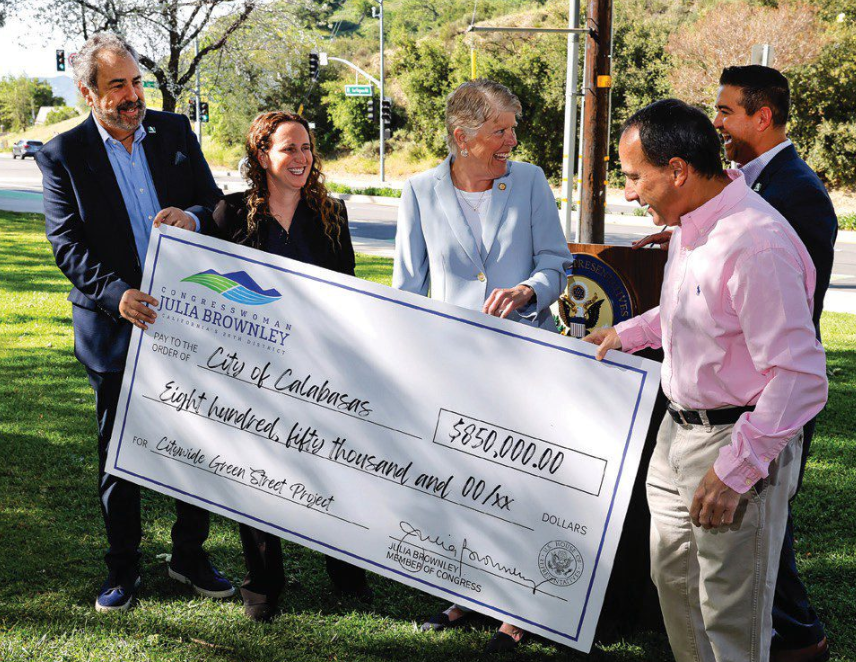
Fri., March 13, was decidedly not unlucky for local communities, as Congresswoman Julia Brownley (CA-26) visited the Conejo Valley area bearing big checks for three projects she helped fund through appropriations legislation.
Since 2013 Brownley has represented a large portion of Ventura County and parts of western Los Angeles County in Congress. The seven-term representative made three stops to dispense federal largesse for fiscal year 2026: $850,000 to the City of Calabasas for its Citywide Green Streets Project; $850,000 to the City of Agoura Hills for its Affordable Housing Microgrid Project; and $1.092 million to the Thousand Oaks-based Calleguas Municipal Water District for its Lake Bard Pump Station Project.
In Calabasas, Brownley met with City Council members and staff at the corner of Las Virgenes and Mureau roads. The city’s Green Streets Project will bring infrastructure improvements to both Mureau and Calabasas Roads, designed to collect and filter stormwater runoff while adding sustainable landscaping along the corridor.
The project will utilize bioswales— shallow channels filled with soil, gravel and vegetation that capture and slow rainwater as it flows off pavement, then work to filter out contaminants. A portion of the water soaks into the ground, instead of entering storm drains.
“The project reduces pollutants from roadway run-off, helping to protect creeks and the Pacific Ocean,” Calabasas Mayor James Bozajian said. “It improves roadway drainage and reduces flooding potential by capturing run-off within landscaped swales, rather than allowing it to flow across the street.”
Bozajian noted that “the visual character” of the roads will also be enhanced “with new landscaping, drought-tolerant plants, and street trees.”
Brownley, who will retire from Congress at the end of her current term, said that “days like today” are what she will miss the most—“Days when a project is developed right here in our community, makes its way through the complexities of the appropriations process in Washington and returns home as real results that improve people’s lives, and that we can celebrate together.”
Having served for more than a decade on the House Transportation and Infrastructure Committee, Brownley said she has “seen firsthand the urgent need to modernize our nation’s infrastructure while confronting the realities of the climate crisis.”
The Calabasas Green Streets Project is an example of investment that protects natural resources and strengthens local economies, she said—something the federal government should support.
To Agoura Hills, Brownley brought funding for an effort to build a microgrid— a small, localized power system— serving a future affordable housing project in the city. The development at Driver Avenue and Colodny Drive in Old Agoura will include 11, single-family prefabricated tiny homes drawing electricity from the shared microgrid.
“Projects like this strengthen our local energy resilience while advancing innovative solutions that support a cleaner environment.” said Mayor Jeremy Wolf.
The project could serve as a pilot model for future developments across the city, according to officials. Brownley previously secured about $1.4 million for a microgrid project at the Agoura Hills Civic Center, aimed at improving infrastructure reliability during extreme weather events.
Across the Los Angeles-Ventura County line, the Calleguas Municipal Water District’s Lake Bard Pump Station Project is set to add 3,000 acre-feet of water to the current system capacity, in part thanks to Brownley’s efforts.
The new pump station will increase emergency supply by approximately 30%, the utility says, helping to maintain reliable drinking water service for residential and commercial customers in Southeastern Ventura County.
In total, as part of the fiscal year 2026 appropriations process, Brownley obtained more than $27.5 million from Uncle Sam to support 12 community projects and other initiatives across Ventura County and the Conejo Valley.
This story was originally published by the Camarillo Acorn on March 21, 2026.
Issues: 119th Congress, Environment, Transportation and Infrastructure